

NEOPOLIS · SKILLS FOR YOUR BUSINESS
AI Data Engineering and RAG Practitioner
Build your team’s skills with “AI Data Engineering and RAG Practitioner”. Design robust data pipelines for RAG: ingestion, parsing, chunking, embeddings, vector and hybrid search, access control, citation handling, and data refresh strategies.
Discuss your team’s needs ↗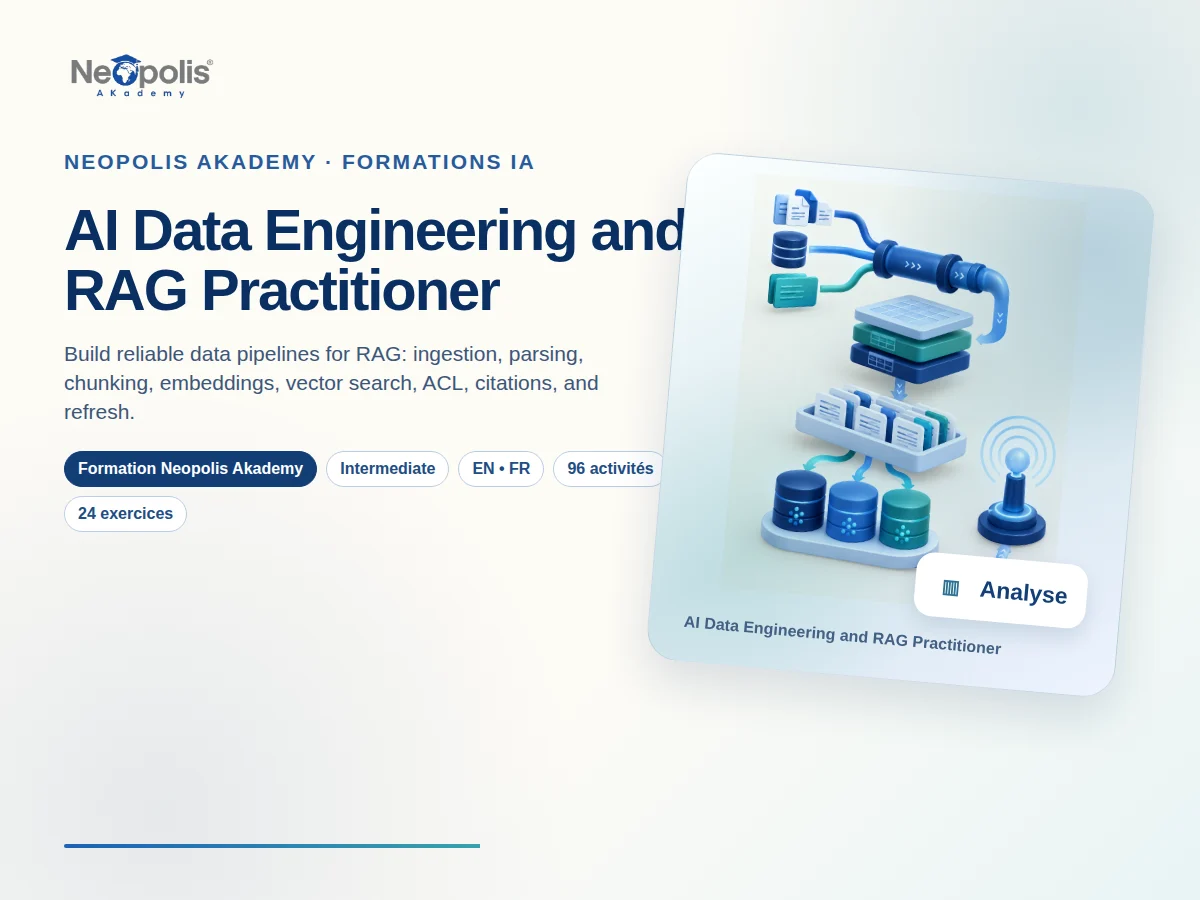
FROM LEARNING TO APPLICATION
Why consider this programme for your business?
Connect an AI prototype to production constraints. Teams need to assess response quality, integrate relevant data and monitor the solution before expanding its use.
Frame a useful first application
Use “AI Data Engineering and RAG Practitioner” as a starting point for a discussion with the team concerned. Select one task, describe the current process and agree on a review method before using real business data.
A starting topic to discuss: “RAG Data Foundations”. Use the programme below to check how it fits your project.
Business framing suggested by Neopolis; it does not add promised outcomes or deliverables to the Akademy programme.
What the Akademy programme covers
This intermediate course addresses preparing sources for RAG, from ingestion to indexed storage.
It details chunking strategies and embedding selection to improve relevance in vector search.
The curriculum covers vector and hybrid search implementations, combining semantic and boolean signals.
It also treats citation handling, access control policies and refresh strategies to keep RAG data current.
Free training for all admitted candidates. Pathway access remains subject to Neopolis Akademy’s admission rules.
Training assisted by Wadaa Rihem.
Content time: 1 hour
Explore the programme
01RAG Data Foundations
Foundational RAG concepts for AI data engineers: architecture, limits and source governance. Covers source inventory, data ownership, freshness, ACLs, parsing common formats (PDF, HTML, Markdown, CSV) and metadata design for citations and filtering.
Describes RAG architecture, when RAG is inappropriate, and core considerations (key concepts and takeaways).
Details source inventory, data ownership, freshness controls and ACLs to support reliable RAG pipelines.
Covers practical parsing approaches for PDFs, HTML, Markdown, CSV and structured records and their impact on indexing.
Outlines metadata design principles to enable accurate citations and effective filtering in RAG retrievals.
View on Akademy ↗02Chunking and Embeddings
Chunking and embedding techniques: chunking strategies (fixed, semantic, recursive, document-aware), embedding model selection including multilingual options, deduplication and normalization, and incremental indexing with re-index triggers.
Compares chunking strategies suited to RAG pipelines and explains trade-offs by document structure.
Presents criteria for choosing embedding models and multilingual considerations for robust vector search.
Describes deduplication, normalization and content hashing methods to reduce redundancy and inconsistencies in indexes.
Explains incremental indexing and re-index triggers to keep data relevant without rebuilding the entire corpus.
View on Akademy ↗03Vector and Hybrid Search
Vector and hybrid search: fundamentals (cosine, dot product, HNSW, IVF), using pgvector for small-to-medium RAG, Qdrant for dedicated vector search with payload filtering, and hybrid BM25+vector+reranking strategies.
Introduces vector search principles (similarity measures, approximate indexes like HNSW/IVF) and their impact on latency/quality.
Explains integrating pgvector into Postgres as a practical option for small-to-medium RAG setups.
Describes Qdrant as a dedicated engine including payload filtering and appropriate usage scenarios.
Outlines hybrid architectures combining BM25, vector search and reranking stages to boost precision and recall.
View on Akademy ↗04Grounded Answers and Citations
Grounded answers and citations: prompt template patterns for grounded responses, source attribution UX, document-level access control, and production operations (refresh, jobs, monitoring, rollback).
Describes prompt template patterns intended to produce responses grounded in retrieved passages and associated best practices.
Covers the UX of presenting citations and attributing sources to preserve traceability of generated answers.
Specifies document-level access control mechanisms and permissions to enforce access rules and confidentiality.
Addresses production operational concerns: data refresh, indexing jobs, pipeline monitoring and rollback strategies.
View on Akademy ↗Practical questions
Where do I enrol?
Enrolment and access to “AI Data Engineering and RAG Practitioner” take place on Neopolis Akademy, a Neopolis Development sub-brand. Admission conditions are specified on Akademy.
Is this course free?
Akademy lists this course as free for admitted candidates. Access remains subject to its admission rules. Any separate business support should be discussed with Neopolis.
Programme published by Neopolis Akademy, a Neopolis Development sub-brand. View the source programme
