
NEOPOLIS · SKILLS FOR YOUR BUSINESS
LLMOps and AI Observability Engineer
Build your team’s skills with “LLMOps and AI Observability Engineer”. Advanced program to instrument and monitor AI systems: traces, tokens, costs, latency, response quality, incidents and SLOs to improve reliability and observability of LLM applications.
Discuss your team’s needs ↗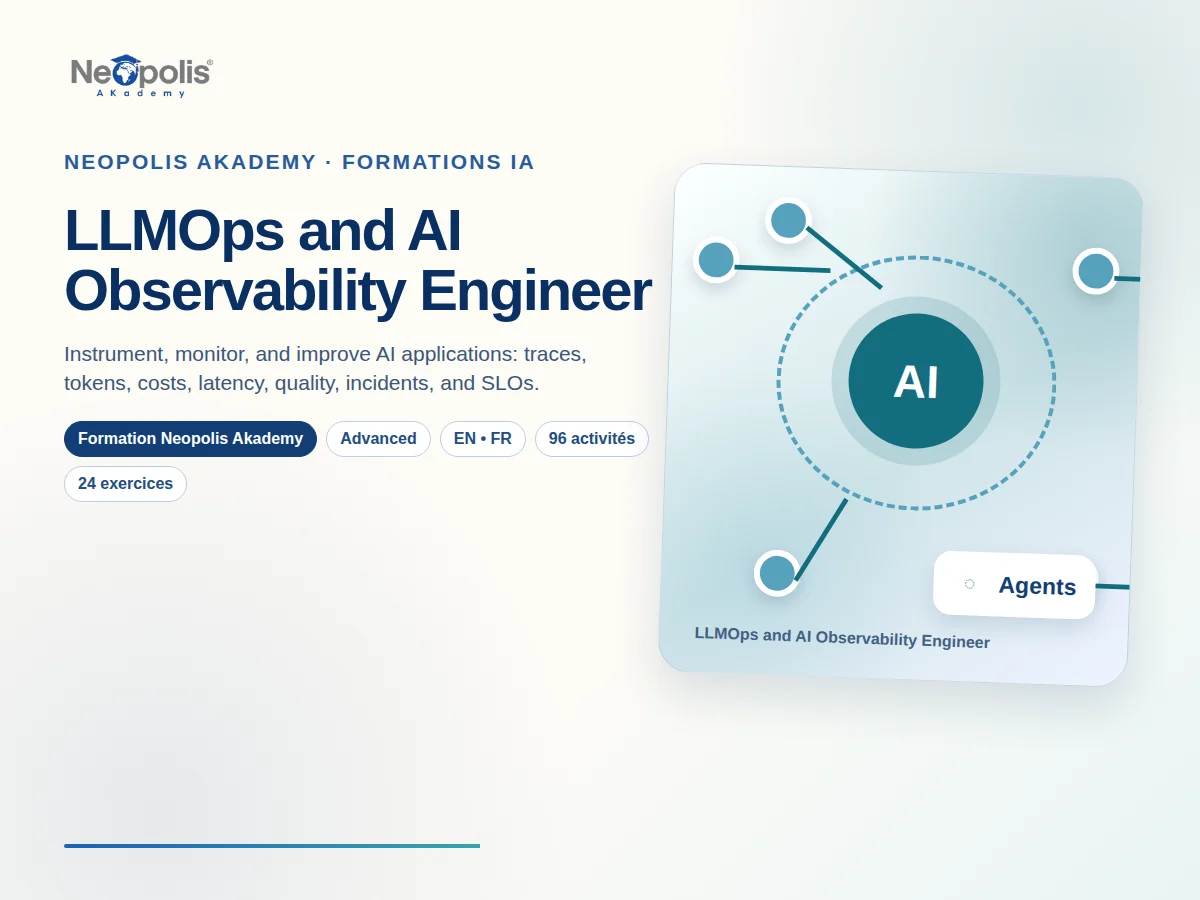
FROM LEARNING TO APPLICATION
Why consider this programme for your business?
Connect an AI prototype to production constraints. Teams need to assess response quality, integrate relevant data and monitor the solution before expanding its use.
Frame a useful first application
Use “LLMOps and AI Observability Engineer” as a starting point for a discussion with the team concerned. Select one task, describe the current process and agree on a review method before using real business data.
A starting topic to discuss: “LLMOps Foundations”. Use the programme below to check how it fits your project.
Business framing suggested by Neopolis; it does not add promised outcomes or deliverables to the Akademy programme.
What the Akademy programme covers
Establishes LLMOps foundations: relevant metrics (tokens, latency, cost), collection architecture and integration with ML/infra pipelines.
Introduces tracing for AI workflows: request correlation, multi‑model chains, cost attribution and execution reconstruction for post‑mortem analysis.
Explains quality monitoring: automated metrics, human sampling, drift detection and dashboards to track degradation and bias.
Covers operations and incident management: alerting, playbooks, post‑mortems and defining/measuring SLOs for LLM services.
Free training for all admitted candidates. Pathway access remains subject to Neopolis Akademy’s admission rules.
Training assisted by Achraf Khelil.
Content time: 1 hour
Explore the programme
01LLMOps Foundations
Foundations of LLMOps and AI observability: differentiate MLOps, LLMOps and app observability, map the AI lifecycle (prompt, retrieval, tools, model, output, feedback), and set SLOs for quality, latency, cost and safety using logs, traces and metrics.
Clarifies how LLMOps differs from traditional MLOps and general app observability.
Details the AI lifecycle: prompt engineering, retrieval, tool integration, model inference, output handling and feedback loops.
Introduces SLO design that treats quality, latency, cost and safety as measurable dimensions.
Explains how logs, traces and metrics complement each other to monitor and debug AI systems.
View on Akademy ↗02Tracing AI Workflows
Tracing AI workflows: instrument model calls (provider, model, tokens, latency), trace RAG retrieval and reranking steps, capture tool calls and agent loops, and apply redaction to protect privacy in traces.
Instrument and log model calls with provider, model version, token usage and latency metadata.
Trace RAG pipeline steps—retrieval and reranking—to establish provenance and relevance diagnostics.
Capture tool invocations and agent loops to detect unwanted behavior or runaway interactions.
Redaction techniques and best practices to protect privacy and limit leakage of sensitive data in traces.
View on Akademy ↗03Quality Monitoring
Quality monitoring: online and offline evaluation strategies, prompt and version tracking, feedback collection and annotation workflows, and regression gates before deployment to prevent performance degradation.
Compares online versus offline evaluation approaches to measure AI output quality in context.
Covers prompt and component version tracking to correlate changes with behavior shifts.
Outlines feedback collection and annotation pipelines to generate labeled signals for monitoring.
Explains regression gates used to ensure no quality regressions are introduced prior to deployment.
View on Akademy ↗04Operations and Incidents
Operations and incident handling for LLM systems: this module addresses monitoring token cost spikes and latency, fallback routing for provider outages, safety-incident triage, and postmortems aimed at continuous reliability improvements for AI services in production.
Detecting and responding to token cost spikes and latency incidents; techniques to identify root causes and mitigate impact.
Designing provider fallback and routing strategies with clear criteria for failover and traffic redistribution.
Triage workflow for safety incidents (e.g., harmful outputs, hallucinations) and guidance on incident prioritization.
Postmortem practice and continuous improvement loops to capture lessons and strengthen AI observability.
View on Akademy ↗Practical questions
Where do I enrol?
Enrolment and access to “LLMOps and AI Observability Engineer” take place on Neopolis Akademy, a Neopolis Development sub-brand. Admission conditions are specified on Akademy.
Is this course free?
Akademy lists this course as free for admitted candidates. Access remains subject to its admission rules. Any separate business support should be discussed with Neopolis.
Programme published by Neopolis Akademy, a Neopolis Development sub-brand. View the source programme