
NEOPOLIS · SKILLS FOR YOUR BUSINESS
Open-Source LLMs and Fine-Tuning Engineer
Build your team’s skills with “Open-Source LLMs and Fine-Tuning Engineer”. Advanced specialization on open‑source models: model selection and adaptation, dataset preparation, PEFT/LoRA/QLoRA/TRL methods, fine‑tuning and evaluation for deployment.
Discuss your team’s needs ↗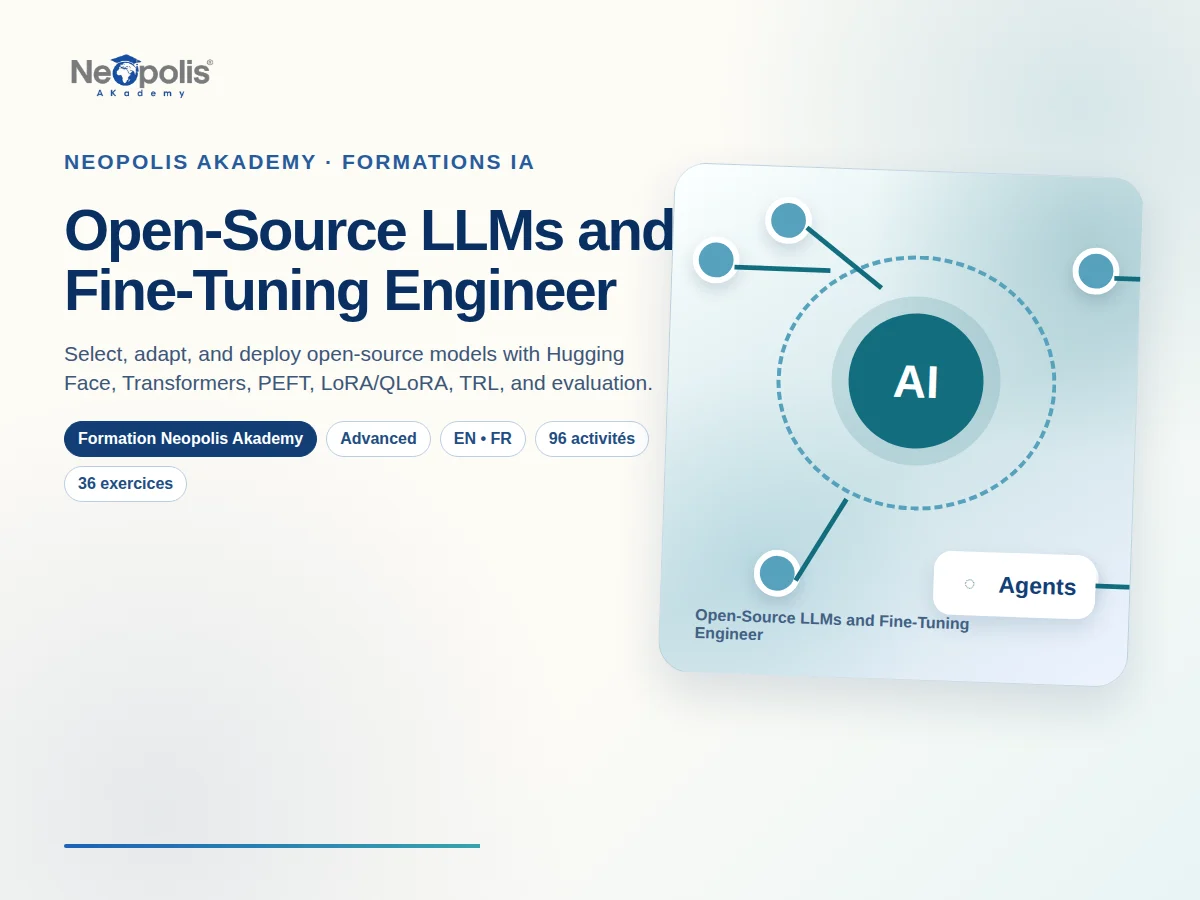
FROM LEARNING TO APPLICATION
Why consider this programme for your business?
Connect an AI prototype to production constraints. Teams need to assess response quality, integrate relevant data and monitor the solution before expanding its use.
Frame a useful first application
Use “Open-Source LLMs and Fine-Tuning Engineer” as a starting point for a discussion with the team concerned. Select one task, describe the current process and agree on a review method before using real business data.
A starting topic to discuss: “Open-Source Model Ecosystem”. Use the programme below to check how it fits your project.
Business framing suggested by Neopolis; it does not add promised outcomes or deliverables to the Akademy programme.
What the Akademy programme covers
Maps the open‑source model ecosystem: model families, properties (size, memory, latency) and selection by use case.
Covers dataset creation and management: cleaning, labeling, splits, evaluation metrics and experiment pipelines.
Describes fine‑tuning and adaptation techniques: PEFT, LoRA/QLoRA, tuning strategies and tools for efficient training of open models.
Addresses packaging and deployment: conversions, inference optimizations, post‑deploy monitoring and continuous evaluation of production models.
Free training for all admitted candidates. Pathway access remains subject to Neopolis Akademy’s admission rules.
Training assisted by Achraf Khelil.
Content time: 1 hour
Explore the programme
01Open-Source Model Ecosystem
Survey of the open-source model ecosystem: model families, licensing and use cases; model hubs and model cards; Transformers pipelines and tokenizers; and how to choose between API, local hosting or fine-tuning for LLM deployment.
Mapping open-source model families, their licenses and suitable use cases.
Understanding model hubs and model cards: how to interpret metadata and linked datasets.
Basics of Transformers pipelines and tokenizers and their impact on performance and cost.
Decision criteria for API use vs local hosting vs fine-tuning based on technical needs and available resources.
View on Akademy ↗02Datasets and Evaluation
Design and evaluation of datasets for fine-tuning: instruction-tuning formatting, train/validation/test split strategies, baseline evaluation before fine-tuning, and checks for bias, leakage and data quality.
Methods to design and format datasets for instruction tuning, including expected data structures.
Train/validation/test split strategies and their influence on evaluation and generalization.
Baseline evaluation to set performance references before applying fine-tuning.
Quality controls: detecting bias, preventing data leakage and best practices to ensure dataset robustness.
View on Akademy ↗03Fine-Tuning Techniques
Comparison of fine‑tuning approaches for open‑source LLMs, detailing full fine‑tuning versus PEFT, deep dives into LoRA/QLoRA and the TRL SFTTrainer, and an examination of hyperparameters and common failure modes to monitor during tuning.
Clear contrast between full fine‑tuning and PEFT approaches, highlighting practical implications for open‑source models.
Deep dive into LoRA and QLoRA: underlying principles, implementation considerations and use cases for efficient parameter tuning.
Walkthrough of the TRL SFTTrainer workflow applied to supervised fine‑tuning with operational cautions.
Review of critical hyperparameters, their impact on training dynamics, and common failure modes to diagnose.
View on Akademy ↗04Packaging and Deployment
Packaging and production readiness for fine‑tuned models: saving and merging adapters, writing model cards and dataset documentation, serving strategies, and cost, governance and lifecycle management considerations.
Steps to save and merge adapters to combine adaptations without altering the backbone, and practical deployment implications.
What to include in a model card and dataset documentation to ensure traceability and reproducibility.
Principles and options for serving fine‑tuned models in production, taking applied adaptations into account.
Cost, governance and lifecycle considerations: maintaining version control, compliance awareness and operational risk management.
View on Akademy ↗Practical questions
Where do I enrol?
Enrolment and access to “Open-Source LLMs and Fine-Tuning Engineer” take place on Neopolis Akademy, a Neopolis Development sub-brand. Admission conditions are specified on Akademy.
Is this course free?
Akademy lists this course as free for admitted candidates. Access remains subject to its admission rules. Any separate business support should be discussed with Neopolis.
Programme published by Neopolis Akademy, a Neopolis Development sub-brand. View the source programme