

NEOPOLIS · SKILLS FOR YOUR BUSINESS
Claude Forward Deployed Engineer
Build your team’s skills with “Claude Forward Deployed Engineer”. This advanced training pathway structures customer-facing Claude delivery: qualifying use cases, running measured pilots, and guiding enterprise adoption from initial activation through expansion.
Discuss your team’s needs ↗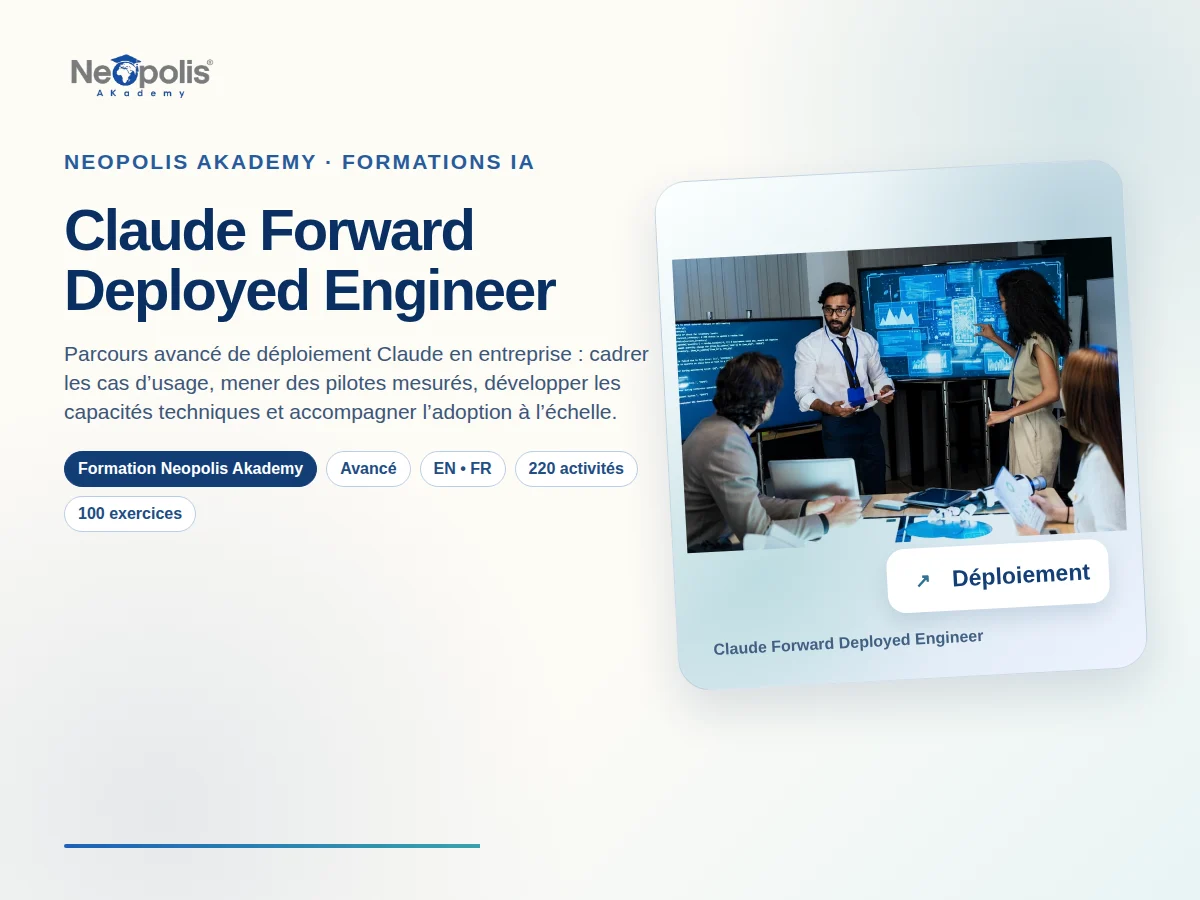
FROM LEARNING TO APPLICATION
Why consider this programme for your business?
Move from an agent demonstration to a controlled business use case. Orchestration matters alongside oversight: tool access, action approval and the ability to diagnose an incorrect result.
Frame a useful first application
Use “Claude Forward Deployed Engineer” as a starting point for a discussion with the team concerned. Select one task, describe the current process and agree on a review method before using real business data.
A starting topic to discuss: “Delivery Methodology”. Use the programme below to check how it fits your project.
Business framing suggested by Neopolis; it does not add promised outcomes or deliverables to the Akademy programme.
What the Akademy programme covers
The pathway connects needs assessment, pilot design and value measurement to establish a practical delivery method for Claude initiatives.
It also covers activation, acceleration and expansion to organise change, develop internal champions and evolve usage across the organisation.
Free training for all admitted candidates. Pathway access remains subject to Neopolis Akademy’s admission rules.
Training assisted by Taher Maamouri.
Content time: 6 hours
Explore the programme
01Delivery Methodology
This course organises a Claude Code delivery method: qualifying use cases, designing pilots, measuring return on investment, and planning a thirty-day activation.
Lessons explain how to select a use case, prepare a measurable pilot and connect the results with organisational priorities.
The pathway addresses champion enablement, common failure modes and the preparation of a progressive Claude Code activation.
View on Akademy ↗02Driving enterprise adoption of Claude
This course guides enterprise Claude adoption from activation through wider rollout by structuring the success team, launch, change management and impact measurement.
Its first steps cover administrative preparation, provisioning, success-team assembly and the conditions for a shared launch.
Acceleration and expansion develop a centre of excellence, continuous enablement, impact measurement and exploration of new use cases.
View on Akademy ↗03Claude 101
The course “Claude 101” comprises 4 lessons. Topics include “Meet Claude”, “Organizing Your Work and Knowledge”.
The learning path includes the lessons “Meet Claude”, “Organizing Your Work and Knowledge”, “Expanding Claude's Reach”, “Putting It All Together”.
Chapter topics include “Getting started with Claude!”, “What is Claude?”, “Video: Your first conversation with Claude”, “Your first conversation with Claude”, “Video: Introduction to projects”, “Introduction to Projects”.
View on Akademy ↗04Claude Code 101
The course “Claude Code 101” comprises 4 lessons. Topics include “What is Claude Code?”, “Your first prompt”.
The learning path includes the lessons “What is Claude Code?”, “Your first prompt”, “Daily workflows”, “Customizing Claude Code”.
Chapter topics include “Video: What is Claude Code?”, “Meet Claude Code”, “What is Claude Code?”, “Video: How Claude Code works”, “Video: Installing Claude Code”, “Installing Claude Code”.
View on Akademy ↗05Claude Code in Action
The course “Claude Code in Action” comprises 4 lessons. Topics include “Steer the Work”, “Configure Claude”.
The learning path includes the lessons “Steer the Work”, “Configure Claude”, “Automate Repeat Work”, “Verify and Share”.
Chapter topics include “Video: Steering Long Sessions”, “Steering Long Sessions”, “Scope it before you run it”, “Rewind, goal, or worktree?”, “Video: A CLAUDE.md That Follows”, “A CLAUDE.md That Follows”.
View on Akademy ↗06Introduction to Agent Skills
Practical introduction to Agent Skills: build, configure and share skills for conversational agents. Covers creating a first skill, multi‑file organization, configuration options, and troubleshooting plus wiring a skill into a frontend reviewer for practical use.
Step‑by‑step creation and activation of a first skill for an agent.
Advanced configuration: multi‑file structuring and tightening the codebase for onboarding.
Contextualizes skills among other Claude Code features and how they differ in practice.
Sharing and troubleshooting: how to share skills, wire them to a frontend reviewer and debug common issues.
View on Akademy ↗07Introduction to Claude Models
The course “Introduction to Claude Models” comprises 3 lessons. Topics include “Introduction à l’API Anthropic”, “Créer des prompts avec Claude”.
The learning path includes the lessons “Introduction à l’API Anthropic”, “Créer des prompts avec Claude”, “Construire des interactions multi-messages”.
Chapter topics include “Qu’est-ce que Claude et l’API Anthropic ?”, “Essayez votre premier prompt pour Claude !”, “Les atouts clés de Claude”, “Faire votre première requête”, “Résumé et réécriture de texte”, “Résumé de texte avec Claude”.
View on Akademy ↗08Introduction to Subagents
Introduction to subagents: concept, design and practical usage. The content details how to structure effective subagents, diagnose weak configurations and apply best-practice usage patterns.
Definition and role of subagents, with functional context for organizing responsibilities in an agent architecture.
Design methods: principles to build reliable subagents and corrective exercises for weak configurations.
Usage guidance to maximize subagent effectiveness within distributed AI workflows.
View on Akademy ↗09Model Context Protocol: Advanced Topics
Deepen your knowledge of the Model Context Protocol (MCP): sampling principles, JSON message types, and building requests/notifications. The content combines theory and hands-on exercises to master client–model communications.
Core MCP features: overview of the protocol and a focused look at sampling, including a walkthrough to understand sampling behaviour.
Transports and communication: classification of JSON message types, hands-on tasks to sort MCP messages and build proper requests and notifications.
View on Akademy ↗10Software Development with Claude Code
The course “Software Development with Claude Code” comprises 4 lessons. Topics include “Getting Started with Claude Code”, “Extending Claude Code”.
The learning path includes the lessons “Getting Started with Claude Code”, “Extending Claude Code”, “Connecting to External Tools with MCP”, “Building a Music CLI”.
Chapter topics include “See Claude Code in Action”, “Getting Started with Claude Code”, “Debug Python Code with Claude Code”, “The Explore-Plan-Code Workflow”, “Custom Agents”, “When to Use Agents”.
View on Akademy ↗11Building Scalable Agentic Systems
Technical approach to designing, developing and deploying scalable agentic systems. Topics include design principles, multi-agent patterns, the Model Context Protocol (MCP) and challenges for large-scale production deployment.
Covers real-world agent characteristics, the agent concept versus non-agent processes, applications, and core design principles for scalable agents.
Discusses multi-agent design patterns, migrating from single-agent to multi-agent architectures, and introduces the Model Context Protocol (MCP).
Addresses scaling to production: moving from proof of concept, reliable testing approaches, remaining verification steps, and fast, efficient data ingestion for production systems.
View on Akademy ↗Practical questions
Where do I enrol?
Enrolment and access to “Claude Forward Deployed Engineer” take place on Neopolis Akademy, a Neopolis Development sub-brand. Admission conditions are specified on Akademy.
Is this course free?
Akademy lists this course as free for admitted candidates. Access remains subject to its admission rules. Any separate business support should be discussed with Neopolis.
Programme published by Neopolis Akademy, a Neopolis Development sub-brand. View the source programme